
Most Indian manufacturers and retailers building customized ERPs or automation tools blow past budgets because they fail to define where standard processes end and custom logic begins. If you are shopping for Custom software development services in India, the initial price tag is rarely the final cost. The real expense hides in the gaps between what your team expects and what the developer builds. Software pricing in the Indian market is not a commodity transaction; it is an ongoing trade off between speed, functional depth, and future scalability. If you run a mid sized manufacturing plant in Pune or a growing retail chain in Delhi, you need systems that handle real world operational friction, not generic features.
To build a realistic budget, look past polished sales pitches and understand exactly where your rupees go. Boardroom spreadsheet calculations rarely survive the first week of user testing on the warehouse floor. True cost containment starts with a clear eyed analysis of your operational reality.
Why standard ERP estimation templates fail Indian businesses
Many business owners download generic pricing templates that assume clean, linear workflows. This is a mistake. In India, your software must handle complex realities like tiered credit terms for distributors, fluctuating freight costs, GST filings across multiple locations, and manual adjustments for unorganized suppliers. Forcing these operational quirks into standard ERP systems skyrockets customization costs.
For example, a standard inventory module tracks stock in and out. A typical Indian manufacturing setup, however, must track raw materials sent to third party job workers, manage yield losses, and reconcile tax invoices across states. If your developer does not understand these workflows from day one, they will write code that requires extensive, expensive rewrites. You are not paying for the code itself; you are paying for the developer to learn your business through trial and error.
Is a fixed price model safer than time and materials?
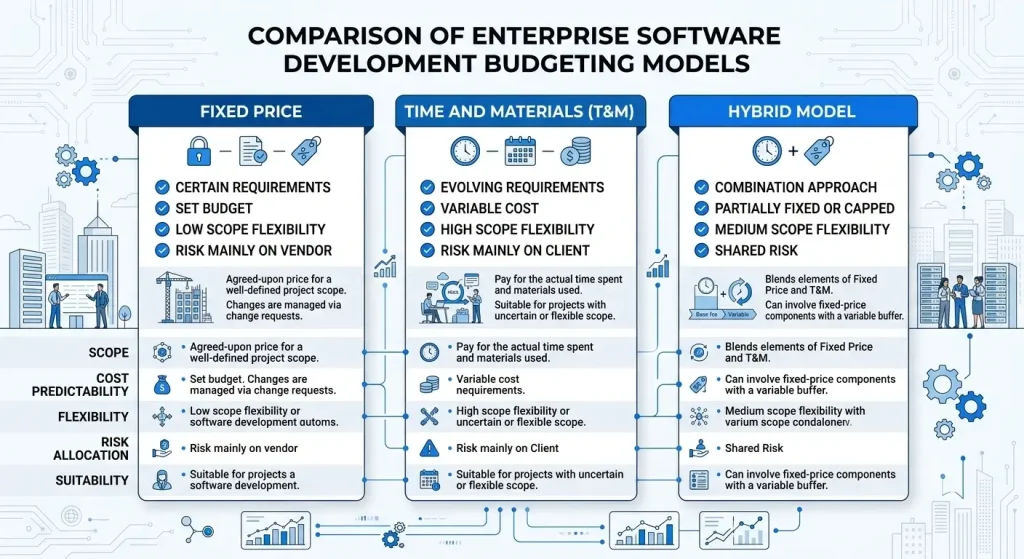
Many promoters prefer a fixed price contract because it offers the illusion of budget certainty. However, software vendors build a massive risk premium, often 40% to 50%, into fixed quotes for projects that are not well defined. Alternatively, they agree to a low price and use every minor change request to extract more money later, leading to a hostile working relationship.
For most business automation projects, a hybrid model works best. You pay a fixed price for the discovery and architecture phase, then transition to a structured time and materials contract with capped monthly budgets for development cycles. This keeps the vendor honest while giving you the flexibility to pivot when an inventory workflow fails on the warehouse floor. Look, it is not perfect. But it is the most practical workaround we have right now. You only pay for actual engineering hours spent on your product, rather than a padded estimate designed to protect vendor margins.
How to evaluate Custom software development services without getting overcharged
To get an accurate estimate, break your project into specific cost centers. Do not ask how much for an ERP. Instead, ask for costs on specific components and integrations to compare proposals on an apples to apples basis and identify which vendors overcharge for basic tasks.
First, consider system integration. If your new software must talk to your existing Tally accounting package, your CRM, or your logistics partner API, complexity increases. Each integration requires custom error handling and data validation. Proper integration requires thorough API documentation, security handshakes, and data mapping. If a vendor claims they can integrate five legacy systems in a week, they are underestimating the work or planning to write fragile code that breaks at the first update.
Secondly, look at user access and security rules. A simple retail system with two user types is cheap to build. A manufacturing system with hierarchical approval loops (operator, supervisor, plant head, finance director) requires complex access control lists. The cost of building these permission layers scales with the number of roles, not just the number of users. Map these roles out before asking for a quote to avoid unexpected charges during development.
Can you do business automation without a full custom build?
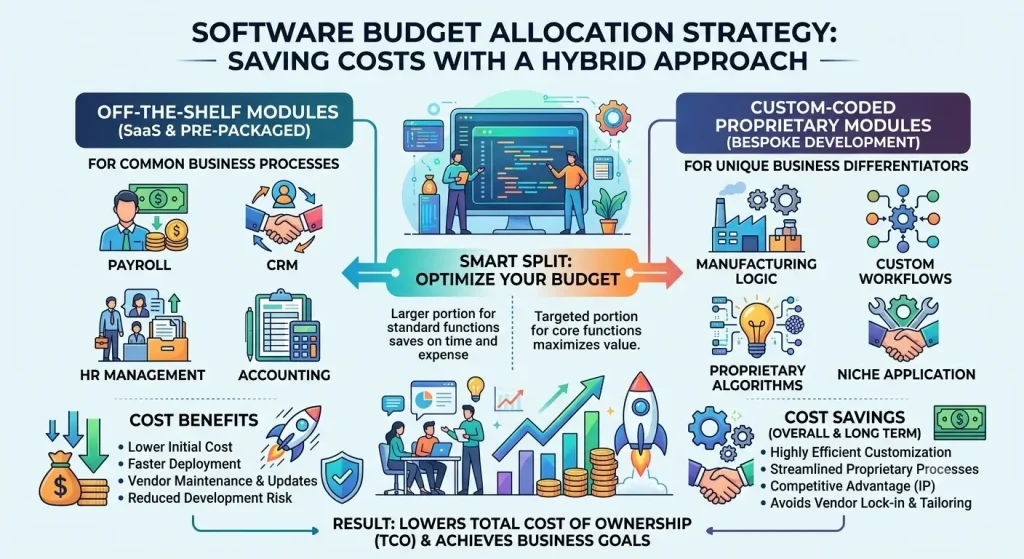
The short answer is yes. You should never pay a developer to write code for standard functions. If you need a payroll system that calculates standard PF and ESIC deductions, use an existing SaaS tool. Focus your custom budget on proprietary processes like your unique raw material mixing formulas, distributor incentive schemes, or proprietary quality control workflows. This is where your competitive advantage lies, and this is where custom code adds real value. This sounds counterintuitive. But in competitive markets, it consistently works.
Separating standard modules from custom modules can reduce your total cost of ownership by up to 40%. Ask your development partner to use open source modules or prebuilt microservices for standard tasks like user authentication or basic reporting. This allows them to focus engineering hours on core business logic, leading to faster deployment, a cleaner code base, and reduced technical debt.
Hidden budget killers in Indian enterprise automation projects
The initial development quote is only part of the equation. In our experience with manufacturers and retailers across India, three specific areas consistently drain budgets post signing. If you do not plan for these expenses from the beginning, you will run out of capital before deployment.
The first is data migration. Moving from old spreadsheets or legacy desktop applications to a modern cloud system requires clean data. Cleaning, formatting, and importing ten years of ledger entries and inventory records takes hundreds of hours of database engineering. If this is not explicitly scoped, expect a heavy bill before go live. In practice, most teams skip this step entirely, and the results show it. Clean your own data in Excel first, rather than paying developers to do basic data entry.
The second is API costs. If your system automatically validates GSTINs, generates e way bills, or sends SMS updates, you will pay ongoing transaction fees to third party API providers. These costs are external to your software development budget, but they must be factored into your operating expenses. Ask your vendor for a detailed breakdown of all third party API dependencies and their monthly costs before signing off on the architecture.
Finally, there is user adoption and training. If your warehouse staff or sales representatives find the system too complicated, they will bypass it. Budgeting for onsite training sessions, simple user manuals in regional languages, and post launch support is non negotiable. Plan to spend at least 10% of your total budget on training and change management to prevent your development budget from being wasted.
Brand Design System: Standardizing UI to control costs
Demanding bespoke user interfaces for every screen is an easy way to blow your budget. At Prime Technologies, we use a structured design system to keep development costs predictable. By utilizing standard components, we minimize custom styling hours and focus our energy on system logic. Our brand system relies on a clean, functional palette: a primary blue (`#106eea`) for active states, neutral background surfaces (`#f7f7f7`), and clear typography with Poppins for headings and clean system fonts for body text. When we build business automation tools, we apply these exact styling standards to keep budgets under control.
First, this reduces frontend design hours because developers use pretested, accessible components that work instantly on both desktop and mobile screens. Secondly, it ensures a consistent user experience. Whether your team is viewing a purchase order on a phone or generating a tax report on a desktop, the interface feels familiar, which drastically reduces training costs. Finally, standardized components lead to fewer UI bugs. Custom layouts often break during browser updates, whereas standardized elements are thoroughly tested and highly stable, saving you money on post launch bug fixes.
How do you handle post-launch maintenance costs?
Do not assume that once the software is launched, your expenses drop to zero. Budget 15% to 20% of the initial development cost annually for maintenance and support. This covers server hosting, security patches, minor workflow adjustments, and API updates. If your business is growing, you will also need to budget for periodic updates to accommodate new tax regulations or business units. Treating software as a one time expense is a recipe for failure; it is an ongoing asset that requires regular maintenance to remain effective.
“The most cost effective software is not the one with the lowest initial bid, but the one that requires the fewest rewrites after it goes live.”
Building software that fits your business and your budget
Budgeting for software development is about managing risk. By defining your workflows early, choosing a hybrid contract model, and avoiding unnecessary custom code for standard processes, you can keep your costs predictable and ensure a high return on investment. Do not let vendors rush you into signing a contract before you have mapped out every user role and legacy integration. The more preparation you do upfront, the less you will pay in change requests later.
If you are ready to automate your operations with a system built for your specific workflow, partner with Prime Technologies for Custom software development services that deliver clean, functional, and budget conscious solutions for Indian enterprises. Explore our custom application engineering options or learn more about our tailored enterprise resource planning systems to start planning your roadmap today. Read our case study on retail workflow automation to see how we help businesses scale.
Build Your Enterprise System with Financial Clarity
Stop overpaying for bloated, generic enterprise solutions. Partner with Prime Technologies to build a high-performance, budget-conscious ERP or automation tool designed strictly around your unique operational workflows. Contact our systems architects today to draft a realistic, transparent development roadmap tailored for your business.
Frequently asked questions
How much does custom software development cost in India?
Costs vary by complexity. A simple business automation tool or custom portal might cost between 5,000 and 15,000 USD (roughly 4 Lakh to 12 Lakh INR). A complex, multi module custom ERP system for a manufacturing plant ranges from 20,000 to over 50,000 USD (16 Lakh to 40 Lakh INR).
Why do custom software projects often go over budget?
The primary reason is scope creep, where new features are added during development without adjusting the budget. Poor data migration planning and undocumented legacy systems also drive up unexpected integration hours during deployment.
Should we build our system on-premise or on the cloud?
Cloud deployment is far more cost effective for most Indian SMEs. It eliminates physical server maintenance, automates backups, and scales easily. On premise is only recommended for strict regulatory compliance requirements.
How long does it take to build a custom ERP system?
A standard custom ERP takes 4 to 9 months to design, build, and test. Rushing this process leads to buggy software and higher stabilization costs post launch, inflating your total budget.
What is the typical payment schedule for software development in India?
Most Indian agencies use milestone based payments: a 20% to 25% upfront deposit, followed by payments tied to specific deliverables like database architecture, core module development, beta release, and final deployment.