

Most automation projects in Indian factories and retail chains fail because the software assumes a perfect operating environment. On the ground, your warehouse staff in Indore or your dispatch team in Chennai works with spotty connectivity, noisy environments, and varying levels of tech literacy. Finding the right software partner requires looking past shiny sales pitches and assessing how they handle real-world friction. To achieve true operational efficiency, you must partner with a Web application development company that designs for the shop floor, not just the air-conditioned boardroom. This choice determines whether your investment yields streamlined operations or expensive shelfware that your staff quietly ignores.
The Reality of Automation in Indian SMEs and Factories
In manufacturing hubs like Ludhiana, Coimbatore, or Surat, operations run on tight margins. When you replace manual ledgers with custom ERP systems, you are not just buying software: you are re-engineering your daily operations. A common mistake is hiring a team that promises a beautiful interface but fails to understand how a physical assembly line or a multi-brand retail counter operates.
Custom workflow automation must accommodate your existing operational habits while eliminating redundant steps. If your workers have to click through five different screens to log a single batch of raw materials, they will bypass the system entirely. The goal of automation is simple: reduce manual data entry, eliminate human error, and provide real-time visibility into your inventory. Achieving this requires a development partner that spends time on your factory floor, observing how your materials move and where your data gets stuck.
Your legacy setups are another major hurdle. Many Indian businesses rely on legacy systems that cannot be ripped out overnight. Whether it is an old desktop-based accounting package or a proprietary warehouse tool, your new web application must communicate with these older systems. A competent partner focuses on building secure middleware or direct database integrations rather than demanding a complete, expensive system overhaul.
Why Your UI/UX Design System Dictates Automation Success
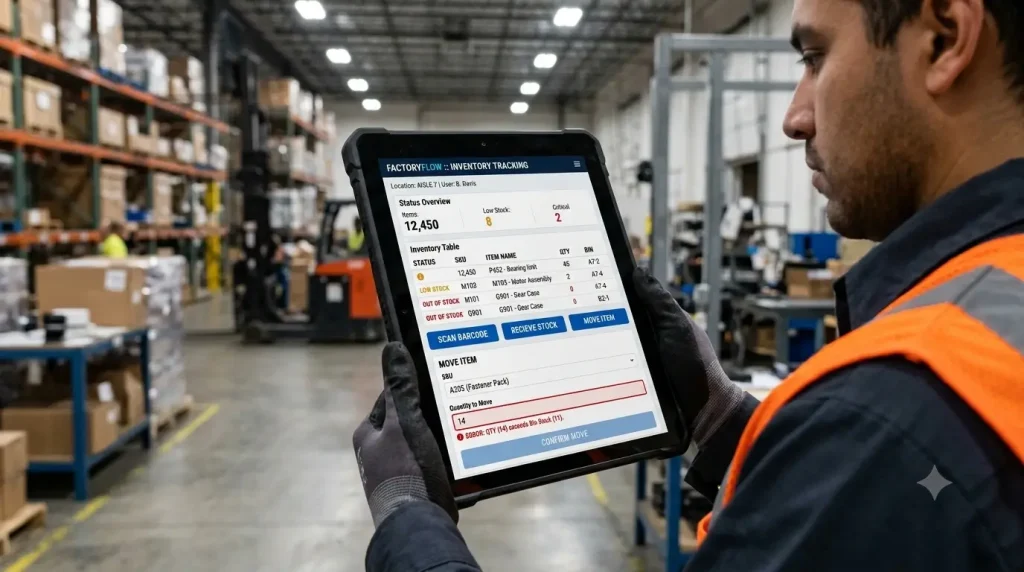
A software design system is not just an aesthetic choice: it is a functional blueprint that dictates user adoption. When we analyze our own internal brand design system at Prime Technologies, we focus on high-contrast visual cues and predictable interactive elements because we know our end users operate under pressure. For example, using a primary blue like #106eea for main actions and a distinct error text color like #c13515 ensures that a busy warehouse operator instantly knows where to click and when an entry has failed. Clean typography and generous spacing are not superficial additions: they are the core of user interface design that keeps your business running smoothly.
Can a structured design system prevent data entry errors on the shop floor?
Absolutely. When your application uses a consistent typography stack (such as Poppins for readable headers and system fonts for data tables) eye strain is reduced. For a manufacturer in Pune or a retailer in Mumbai, small details matter. Buttons must have a minimum height of 48px to prevent misclicks on touchscreens. Form fields must have generous padding and use clear labels instead of placeholder text that disappears. These practical interface choices directly impact your business metrics by reducing data correction cycles and training times for employees.
If development teams build every screen from scratch without a reusable component library, your application will look like a patchwork quilt. This lack of consistency leads to cognitive overload for your staff, driving up error rates. A disciplined team uses a unified system of colors, spacing, and typography to build intuitive interfaces that require minimal training.
How to Evaluate a Web application development company for Custom ERP Integrations
When you start interviewing potential partners, you will hear a lot of talk about modern tech stacks and cloud scalability. You need to cut through this noise by asking highly specific technical questions. Your focus should be on how they handle API integration, database architecture, and offline data survival.
Many parts of India face erratic internet connectivity. If your web application relies on a continuous, high-speed connection, your warehouse operations will grind to a halt during an outage. Your development partner must have experience building offline-first capabilities. This means the application can store data locally in the browser and handle data synchronization seamlessly once the network is restored. Ask them to explain their conflict-resolution strategy when multiple offline devices sync back to the main server simultaneously: their answer will tell you immediately if they are senior engineers or junior developers reading from a script.
Database performance is another area where weak teams stumble. A system that runs fast with ten test users will crawl to a stop when fifty real-world users start generating transactions and updating stock levels simultaneously. Your partner must demonstrate deep expertise in database optimization, indexing, and query design. They should be able to explain how they structure database schemas to handle rapid growth without sacrificing speed. To learn more about how we structure these high-performance databases, explore our approach to custom ERP systems in India.
Can you build custom automation without replacing your existing accounting software?
Yes, and in most cases, you should. If your finance team is comfortable with Tally, forcing them onto a completely new system is a recipe for internal rebellion. A smart automation partner will preserve your core accounting setup and build a custom web portal that handles front-end operations (such as sales dispatch or purchase orders) and then syncs that data directly via a secure Tally ERP integration. This hybrid approach keeps your back-office operations stable while giving your operational teams the modern tools they need. You can read about how we implemented this hybrid model for a major retail distributor in our retail inventory automation case study.
Is a fixed-bid contract a trap for complex automation?
For simple, static websites, a fixed-bid contract works. For complex business automation, it is often a recipe for conflict. When you automate a business process, you inevitably discover hidden exceptions and workflows that were never documented. Under a rigid fixed-bid contract, every minor adjustment becomes a change request that requires renegotiation, stalling your project for weeks. A more realistic approach is a time-and-materials model with clear milestone-based pricing. This gives you the flexibility to adapt the software as real-world testing reveals gaps, ensuring the final product matches your actual operational needs rather than an outdated specification document.
Red Flags to Avoid During Your Selection Process
The software industry is filled with agencies that talk a great game during sales pitches but outsource the development or assign junior engineers to your project. To protect your business, watch out for several warning signs. First, be highly skeptical of the yes-man syndrome. If a developer agrees to every single feature request without questioning its operational feasibility, they lack the experience required for complex automation. Seasoned practitioners know that building every feature on a wishlist leads to bloated, unusable software. A reliable partner will push back, suggest simpler alternatives, and focus on your core operational bottlenecks first.
Second, avoid partners that lack domain experience. Building a social media app is entirely different from building an inventory tracking system for a textile mill or a retail chain. If the development team has never worked with physical supply chains, manufacturing workflows, or complex warehouse environments, they will waste months of your time learning basic industry concepts on your dime. Look for a team that can speak your industry’s language from day one.
Third, watch out for vague post-launch support agreements. Software is a living system. Once your staff starts using the application, bugs will emerge and workflows will need adjustment. If a company does not offer a clear, SLA-backed maintenance agreement, you risk being left stranded with a broken system during a critical business period. Before making a final commitment, ask to speak directly with the lead architect who will design your system. Ask them to explain how they plan to handle your specific data volume and user load. Their ability to explain complex technical concepts in plain, practical business terms is a reliable indicator of competence.
Successful automation is never about buying code: it is about investing in a partnership that understands your business operations, respects your legacy constraints, and builds for the people on the ground.
Building for Long-Term Operational Scale
Choosing a Web application development company is one of the most critical decisions your business will make this year. The right choice will streamline your operations, protect your margins, and give you the real-time visibility you need to grow. If you are ready to build practical, high-performance automation systems that fit your specific operational workflows, check out our proven track record in our manufacturing efficiency case studies and let us help you build a system that works.
Frequently asked questions
How long does it typically take to build a custom web application for warehouse automation?
A standard custom warehouse application takes between three to six months to develop. This timeline includes deep workflow analysis, database design, user interface development, and extensive on-site testing.
Can we integrate a custom web application with our existing legacy ERP?
Yes, custom web applications can connect with legacy ERPs using APIs or direct database connections. A skilled partner will design secure middleware to handle data exchange without compromising legacy system stability.
How do you handle data security when building custom business automation?
Security must be built in from the ground up. This includes implementing role-based access control, encrypting sensitive data both in transit and at rest, and conducting regular vulnerability assessments to protect your system.
What happens if our internet connection goes down during warehouse operations?
To prevent downtime, we build offline-first capabilities into the application. This allows your team to continue scanning barcodes and logging inventory locally, with all data syncing automatically once connectivity is restored.
How do we ensure our ground staff adopts the new software?
User adoption is driven by simplicity and direct involvement. We involve your ground staff early in the design process, keep the user interface highly intuitive with large touch targets, and provide hands-on training sessions during deployment.